If you’ve seen the scales creep up around perimenopause or menopause and you’ve started (or are considering) HRT, it’s completely normal to wonder about HRT and weight changes. Here’s the UK- grounded takeaway.
The NHS is very direct: there’s little evidence that most types of HRT make you put on weight. The NHS also notes that many people gain weight during menopause and with age whether they take HRT or not, and recommends regular exercise plus a balanced diet for weight management.
UK menopause specialists echo that message. A Women’s Health Concern factsheet (produced with the British Menopause Society) says there is no evidence that HRT is responsible for weight gain, although some women experience bloating and fluid retention with certain HRT types and this usually settles over time.
So, in the UK context, the most accurate answer to “does HRT lead to weight gain in women?” is: HRT itself does not usually cause meaningful fat gain, but midlife body changes often happen at the same time. And those timing coincidences can be very convincing on a bathroom scale.
Why weight changes during menopause get blamed on HRT
Menopause, aging, and the “same habits, different results” problem
Weight change in midlife rarely has one cause. A 2024 peer‑reviewed clinical review summarising large cohorts reports that aging-related changes (like reduced energy expenditure and reduced physical activity) strongly contribute to weight gain in midlife women, while menopause-related hormonal changes also influence where fat is stored, tending toward more central (abdominal) adiposity.
That same review highlights a key SWAN (Study of Women’s Health Across the Nation) finding: participants gained about 0.7 kg per year on average, and this happened broadly across midlife. This aligns with UK specialist materials that describe gradual midlife gain as common, even before HRT enters the conversation.
Abdominal weight gain is common in midlife, with or without HRT
Many people specifically ask: is HRT the cause of abdominal weight gain? UK clinician tools from the British Menopause Society emphasise that most weight gained around this transition tends to collect
around the abdomen and upper body. They also describe an increase in visceral fat as estrogen levels fall and note that metabolic rate slows as lean muscle mass reduces.
A Women’s Health Concern factsheet makes a similar point: midlife weight often accumulates around the middle, shifting body shape and affecting health risk more than weight stored elsewhere. In other words, many headlines about HRT and menopause-related weight gain UK are really describing menopause and aging, not an HRT “fat gain switch.”
What clinical studies actually show about HRT and weight gain
This is where the “hormone therapy side effects weight gain UK” question deserves a careful distinction: are we talking about true fat gain, body water, or body composition changes?
Main findings from guidelines and clinical research
The strongest consistent signal across controlled studies and systematic reviews is not “HRT causes weight gain.” If anything, several datasets show neutral weight effects or slightly less gain versus placebo, with small effect sizes.
| Source | Type | Population / Timeframe | What it Found About Weight or Body Composition | Practical Meaning for “Weight Gain After HRT in the UK” |
| NHS (HRT side effects page) | UK public health guidance | General public | “Little evidence” that most HRT types cause weight gain; weight gain can occur during menopause/aging regardless; exercise + balanced diet advised | HRT is not usually the main driver of fat gain; lifestyle still matters |
| NHS Medicines Guidance | UK specialist health guidance | Women experiencing menopause | No evidence HRT causes weight gain; some women experience bloating/fluid retention, but it’s often temporary | Early “puffiness” and fluid retention may happen, but it’s not fat gain and usually settles |
| British Menopause Society Tool for Clinicians | UK specialist clinician resource | Perimenopause/menopause | Weight gain common in transition; average gains described; more abdominal fat; metabolic rate slows with muscle loss | Menopause itself changes body composition; blaming HRT misses the real pattern |
| Espeland et al., 1997 (PEPI Trial) | Randomized placebo-controlled trial | 875 women, 3 years | Women on estrogen (with/without progestogen) gained 1.0 kg less vs placebo at 3 years; smaller increases in waist girth | HRT did not cause extra weight gain; it may slightly reduce gain |
| Norman et al., 2000 (Cochrane Review) | Systematic review of RCTs | 22 RCTs included | No significant difference in mean weight gain vs non-HRT users (including combined regimens) | Best “big picture” evidence: HRT doesn’t cause extra weight gain beyond normal menopause changes |
| Chen et al., 2005 (WHI Substudy) | Randomized trial substudy | 835 women, 3 years | Estrogen + progestin group lost less lean soft tissue mass and showed a small favorable shift in trunk-to-leg fat distribution ratio vs placebo | HRT may shift body composition, but weight might not change significantly |
A simple chart of what one major RCT observed
The PEPI randomized trial result is easy to visualize because it reports differences versus placebo at 3 years.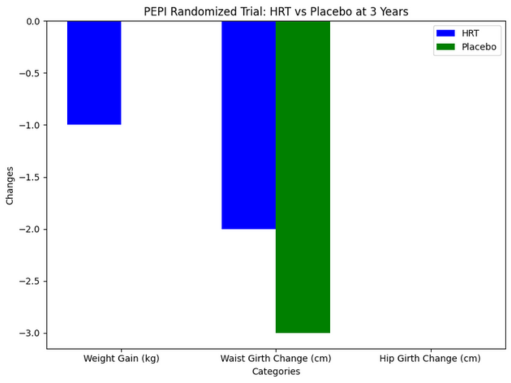
Bar chart showing differences in weight, waist girth, and hip girth changes for HRT vs placebo at 3 year
In this trial, women assigned to estrogen (with or without a progestational agent) had about 1.0 kg less weight gain than placebo at 3 years, with a smaller rise in waist girth as well.
This does not mean HRT is a weight-loss plan (sorry). It suggests that, on average, how HRT affects weight in women is usually neutral, and in some settings slightly favorable.
Metabolism matters, even when scales barely move
People searching “HRT impact on metabolism UK” are often asking a smart question: could HRT affect insulin resistance or diabetes risk even if weight stays similar?
A large randomized WHI analysis (Diabetologia) found lower incidence of treated diabetes in the estrogen-plus-progestin group compared with placebo (hazard ratio 0.79), and reported improved insulin resistance markers in the first year in treated women. This does not prove HRT “melts fat,” but it supports the idea that metabolism can shift somewhat independent of body size.
What feels like weight gain, but often isn’t fat gain
Does hormone replacement therapy cause bloating?
Sometimes, yes. Not always, and usually not forever.
A UK Women’s Health Concern factsheet states that while HRT is not supported as a cause of weight gain, some women may experience bloating and fluid retention with certain application types, and it typically settles over time.
That “settles over time” point matters. The NHS also explains that many HRT side effects improve with time, and it can help to continue treatment for around 3 months if possible.
If you’ve ever watched the scale jump after a salty takeaway, you already know the punchline: your body can store water faster than it can store fat. The scale doesn’t file an expense report explaining the difference, unfortunately.
Hormonal therapy weight fluctuations in the UK: why the first weeks can be noisy
Even without true fat gain, several things can change quickly when symptoms improve or hormones shift:
Sleep, mood, and joint pain can shape activity levels and food choices. A Women’s Health Concern factsheet notes that symptoms like insomnia, low mood, and aching joints can make weight management more challenging, and it can be easier to address weight when other symptoms feel under control.
HRT can also cause side effects that overlap with menopause symptoms, which can confuse the timeline. The NHS explicitly notes that HRT side effects can resemble menopause symptoms, so HRT may not be the cause of every new sensation
Weight management during HRT treatment in the UK
This section is your practical UK guide to weight gain and HRT, focusing on what actually moves the needle for health and body composition.
Keep the basics boring (because boring works)
The NHS recommendation for adults includes 150 minutes of moderate activity per week (or 75 minutes vigorous) and strengthening activities at least 2 days per week. It also advises reducing long periods of sitting by breaking them up. For menopause specifically, the NHS “things you can do” page supports regular exercise, including resistance activities, alongside healthy diet basics.
That combination directly supports weight management during HRT treatment because it targets the two big midlife shifts: lower daily movement and lower lean mass.
Food strategy: aim for consistency, not perfection
If your goal is HRT and healthy weight maintenance, NHS resources emphasise balanced eating patterns and sensible weight management support rather than extreme restrictions.
The NHS balanced diet guidance points to structured support like the free NHS Weight Loss Plan, designed for safe weight loss and habit building.
The NHS also maintains a “managing your weight” hub and practical tips for weight loss, which can help you tailor changes without reinventing nutrition from scratch.
If you want hormone replacement therapy weight control tips UK style, here are evidence-aligned approaches that fit UK public health guidance: Prioritise strength training twice weekly, because muscle supports metabolic rate and function as we age. Build weekly movement toward the NHS activity targets in any pattern you can sustain, including brisk walking and resistance sessions.
Use NHS-backed structured tools if you prefer a step-by-step plan rather than guesswork.
What about “can HRT cause fat accumulation”?
The best available evidence does not support HRT as a direct cause of extra fat accumulation beyond what many women experience during the menopause transition. A Cochrane systematic review of RCTs found no statistically significant difference in mean weight gain between combined estrogen/progestogen therapy users and non‑HRT users.
At the same time, some clinical trial data suggest small favorable differences in waist measures or fat distribution with hormone therapy, though effects are modest.
Put simply: HRT is not a reliable fat-loss tool, but it also is not a reliable fat-gain trigger.
When to speak with a GP in the UK
If you’re dealing with unexpected changes, your GP or menopause clinic can help you sort out whether you’re seeing side effects, natural midlife change, or something unrelated.
The NHS advises speaking with a GP if side effects are severe or persist beyond a few months, and notes that clinicians can adjust dose, type, or delivery method (for example switching from tablets to patches) to improve tolerability.
Consider checking in sooner if:
Your weight change is rapid and unexplained (especially with swelling, breathlessness, or chest symptoms). HRT can slightly raise blood clot risk and a clinician should assess concerning symptoms promptly.
You’re struggling with persistent bloating or fluid retention and it isn’t settling. Women’s Health Concern notes that these symptoms can occur and usually settle, but not everyone follows the average timeline.
Your main goal is HRT and weight loss prevention rather than symptom relief. A clinician can help you set
realistic expectations and match treatments to your actual symptoms and health profile.
Sources:
Side effects of hormone replacement therapy (HRT) – NHS
womens-health-concern.org
https://www.womens-health-concern.org/wp-content/uploads/2023/06/31-WHC-FACTSHEET-Weight-Gain-and-menopause- JUNE2023-A.pdf
Weight Gain in Midlife Women – PMC
https://pmc.ncbi.nlm.nih.gov/articles/PMC11150086/
thebms.org.uk
Effect of postmenopausal hormone therapy on body weight and waist and hip girths.
Postmenopausal Estrogen-Progestin Interventions Study Investigators – PubMed
https://pubmed.ncbi.nlm.nih.gov/9141548/
Oestrogen and progestogen hormone replacement therapy for peri-menopausal and post- menopausal women: weight and body fat distribution – PubMed
https://pubmed.ncbi.nlm.nih.gov/10796730/
Postmenopausal hormone therapy and body composition—a substudy of the estrogen plus progestin trial of the Women’s Health Initiative – ScienceDirect
https://www.sciencedirect.com/science/article/pii/S0002916523296148
Effect of oestrogen plus progestin on the incidence of diabetes in postmenopausal women: results from the Women’s Health Initiative Hormone Trial | Diabetologia | Springer Nature Link https://link.springer.com/article/10.1007/s00125-004-1448-x
Physical activity guidelines for adults aged 19 to 64
Menopause – Things you can do
https://www.nhs.uk/conditions/menopause/things-you-can-do/?utm_source=chatgpt.com